Wednesday, September 2, 2015

Promotion of Indigenous Foods: Culturally Appropriate or Appropriative?


Recently, there has been a push for the appreciation and protection of indigenous foods. These foods, many of which have been 'underutilised' and 'undervalued' in global agri-food systems until now, include crops such as millet, quinoa, algae, weeds and hemp, along with species such as edible insects. 

Despite their huge role in food security and household resilience in developing and rural economies, many have not been typically traded as commodities in a classical economic sense, and have often been labelled as 'invasive' or 'famine foods'. Now, they are gaining traction due to their diverse nutritional portfolio, genetic diversity, environmental adaptability and efficient, low input production characteristics. From policy makers, think tanks to local entrepreneurs, indigenous foods are now pivotal to achieving sustainable and healthy global diets. 

The UN FAO defines a sustainable diet as: "protective and respectful of biodiversity and ecosystems, culturally appropriate, accessible, economically fair and affordable; nutritionally adequate, safe and healthy; while optimising natural and human resources". 

While this is an optimistic rhetoric, I am increasingly aware of the pitfalls of incorporating indigenous foods into global sustainable diets. My main question is, while cultural appropriateness is aimed for, can we appreciate and integrate indigenous foods without being culturally appropriative? 

The first point I want to make concerns knowledge and whose voice counts. One path taken to support indigenous food culture is increased education and awareness, including Slow Food's Ark of Taste and Food Tank's list of indigenous crops 'promoting health and feeding the world'. 

I have also been working a lot on this side of things, doing taste education events to talk about entomophagy and its link to culture, environment and policy. My aim is not to frame insects as a universal solution, but more to explore the geography and diversity surrounding entomophagy and see how we can learn from this.

However, despite these intentions, the first questions people ask in interviews are: "So, what is your favourite insect?" and "You're trying to make us all eat bugs?". There is an automatic jump from raising awareness and educating people to an assumed promotion or marketing of edible insects as a mainstream food for all. It also shows how I - a white, middle class and educated woman - have become the subject rather than the insect species or 'traditional cultures' themselves.


This raises the question: As we are able to learn more about the benefits and diversity of traditional diets, cultures and ecologies, does it become our right as academics, development experts and 'foodies' to market elements of this system as discrete food products? Furthermore, do we have the right to be the face of this movement?


Six Foods: A start-up selling cricket snack products, part of Harvard Innovation Lab
Source: Six Foods Kickstarter
Myself, Charlotte and Annie being photographed for the Oxford Mail
Source: Oxford Mail 
My second point relates to the valorisation/commodification of indigenous food. 

I am all for the creation of a transnational moral economy in which indigeneity and sustainability are used to re-connect culture with nature and producer with consumer. However, when it comes to value addition, there is often a conflation of protection of traditional foods - one of the premises of a 'sustainable diet' - and promotion. The latter arguably prioritises technical, financial and end product value over the socio-cultural, ecological and political value. 

The branding of indigenous food as 'novel' or 'alternative protein sources', or selling them in snack bar and niche health food form, are cases in point. While brands and certifications are means to encourage consumer acceptance, especially with unknown foods such as edible insects, the product is arguably abstracted from its original context and defined simply by our own valuations of taste, diet and what makes 'quality food'.

Furthermore, by subsuming these foods within universal health and sustainability indicators such as 'gluten-free' or 'wholefoods', they can easily be replaced by another. I have seen so many articles as of late saying that algae is the 'new soy', or millet is the 'new superfood'. While the commodity may be replaceable or replicable, the food itself and its context should not be: there is so much diversity (nutritional, geographic, cultural, genetic...) even within one type of indigenous food, let alone between them.

Amaranth: Branded as 'gluten free' 'protein rich' heritage crop.
Source: iherb.com

Exo cricket flour protein bar: 'all natural' 'gluten-free'
Source: exo
A final issue is 'disneyfication'. In other words, when complex issues such as famine, conflict and other humanitarian crises are simplified into a compelling narrative to help conjure empathy and promote aid giving. There is usually a victim, a disaster and a saviour. 

In relation to indigenous food cultures: the victim is the smallholder farmer; the disaster is globalisation and an erosion of traditional diets, agricultural practices and knowledge; and the saviour is 'Us', from Western ethical consumers to philanthrocapitalists and policy makers. 

This story directly links consumers and producers together in an emotive tale, but it is assumptive. For example, if we protect (and buy) the foods in global agro-food systems, there will be an adjacent protection/preservation of the traditional cultures, livelihoods and ecosystems in which the food is embedded. The point I made above about the commodification of 'tradition' and branding of indigenous foods suggests otherwise. 

Second, on the flip side of commodification, there is a risk of romanticising and patronising. Just because we are starting to realise the potential of indigenous foods and their cultural context, does this mean we have the right to tell smallholder producers or harvesters to preserve and appreciate them too?  Surely, if we want to be culturally appropriate, we need to recognise and respect their choice to 'modernise'?

I will give one anecdote from my own research on millet diversity in rural Uttarakhand, India. Despite a push for preserving and promoting millet as a 'superfood' in urban Indian centres, and framing it as a resilient climate-friendly crop, I noticed that millet was declining in popularity in rural areas for several reasons.

First, markets were either geographically distant or, to sell millet, you had to match criteria in terms of safety, quality, quantity and uniformity. Second, many millet varieties - particularly minor millets - take a long time to de-husk and process. This is done by women, who also have to take care of a huge host of other domestic and agricultural tasks. Third, perhaps due to colonial legacy, social status was linked to consuming white foods. With ragi (finger millet) being a dark grey-black hue when ground, it was seen as 'dirtier' and 'less modern' than rice, wheat and processed meals such as Maggi noodles. 

Finally, it was simply more practical to eat other foods. This included buying wheat and rice at a subsidised rate from the Public Distribution System, or getting free dhal and rice in free school meals. Also, while millet tastes good when hot, it goes hard like a stone when cold. As people started off-farm jobs to supplement agricultural livelihoods, they would prioritise other more palatable foods that could be taken to work in nearby cities.


Women at work: the rain-fed terraces in rural Uttarakhand
De-husking a grain using traditional methods: it takes up to 20 hours of manual labour to do a whole bag.
This is just one story, and by no means does it do justice to the complex reality, but it does indicate that the 'disneyfied' narrative sidelines realities such as time and labour costs (particularly those falling on women), market access, conflicting policies and subsidies, and - ironically - the impact our Western legacy has had on social taste and diets. 

Linking back to the definition of 'sustainable diets', including the need to respect ecosystems, be culturally appropriate and make an accessible and fair food system, I think we need to realise that it is not simply about respecting and being culturally appropriate towards indigenous cultures, but respecting power relations and a legacy of interaction between 'Western' and 'indigenous' knowledge frameworks, food and agricultural systems. We cannot suddenly dismiss these in light of a new-found appreciation of indigenous food.

For me, it is all about balance: a balance between learning about indigenous food culture and not abusing our power as 'dominant knowledge communicators' by becoming the face of the movement ourselves; a balance between valuing indigenous foods in globalised systems and the romanticisation or 'setting apart' of the cultures and environments they have come from. Without this, we will continue to risk appropriating - i.e. setting apart the actors and contexts within sustainable, global food systems - rather than truly appreciating. 

Saturday, August 29, 2015

Bybi: How Society Can Learn From Honey Bees


Last week I had the pleasure of going along to Bybi to embark on a 'hive to honey jar' adventure. The event was part of Copenhagen Cooking, a two week festival which claims to be the largest food festival in northern Europe, crammed with over 150 events across the city. Clearly, I was going to be interested in any insect-related event, so the fact that I leaped at the chance to explore Copenhagen's honey bee hives wasn't really surprising. 


Bee larvae: fatty, creamy and nutty like hazelnuts. 
Anna and I at the bee hives
The hives themselves. Bees enter at the bottom, honey is collected at the top

Scraping away the waxy propolis to get to the honey
Gonna get me some honey (from a centrifuge)

Bybi literally means 'Bee City', and while this does explain the organisation in terms of its geographical location (within the city of Copenhagen) and its purpose (urban bee keeping), there is much more to the name than you think.

The founder, Oliver, realised that bee hives are, in themselves, little bee cities: 

"The bee hive reflects human society; it is a democracy, an organised hive with a Queen Bee and female workers tirelessly producing and enriching the environment around them". He jokes, "Then you get the Drones, the men of the hive: they are eyes, balls and nothing else. They are fat, lazy and stay indoors. In a way, that's a reflection on human society too...
What is most pertinent is how honey bees organise themselves and use their skills not to destroy the environment around them but to produce to support and make their society more colourful. It is this message that inspired Oliver to use bee hives as a model for how society should be - colourful, supportive and built on strong relationships. 

"We believe that our city will be even lovelier when all businesses are rooted in the local community. That's why we rent beehives to the city's businesses". 

Not only does this make a refreshing change from the common dichotomisation of nature and culture, but it also turns our relationship with nature on its head: we should not aim to overcome or harness nature, but use ecosystems and their intricacy to learn and build sustainable societies.

"Show me the honey" - Not only sustainable, but Bybi has a sense of humour too...

Bybi's organisational structure is a case in point. The hives are produced in collaboration with Sundholm, an activity centre with a wood workshop. Going from hives to homes, Bybi also has teamed with charities to provide social housing projects. Residents - including asylum seekers, homeless and long term unemployed groups, and refugees - are then provided with the bee hives and skills to become bee keepers. 

Overall, a network is created between the honey bees, ecosystems, different organisations and individuals living in Copenhagen; all of which is built on social enterprise, sustainability and capacity. 

Alongside sustainability, diversity is also encouraged. Every district has distinct flora, so every hive will produce a different colour and taste of honey; a reflection of the diversity of people and ecosystems in Copenhagen. 

Even the products themselves are supportive of a diverse utilisation of honey bees. Instead of domesticating honey bees simply for honey production, the other byproducts such as bee bread (a protein-rich amalgamation of pollen and honey) and the bee larvae are sold locally. The honey is also used to make confectionary, beers and ice cream.

Bybi beer. Bien. 

To communicate the above and showcase their products and passion, Bybi hosted a seven course meal in collaboration with the local pop-up Skeletske. By combining a variety of different honeys from Copenhagen and using local, foraged and Nordic ingredients, each course held a unique story which merged society, ecology and gastronomy together. 

Honey from different Copenhagen districts, pollen, propolis and bee bread. Lit up by a bees wax candle

For me, the highlight was the pickled mackerel with honey and bee bread. Bee bread is essentially the pulverised pollen and honey that is used as food for worker bees. It has an initial flavour similar to silk worms (which, as they are domesticated and fed mulberries, have a grassy aroma and flavour), then gets sweeter as you chew it. In Nordic cuisine, mackerel with sour dough or rye is a classic, and so the bee bread morsels helped give a similar nutty, malty flavour to the dish. 

Sour wild plum, biodynamic pork braised in honey beer, foraged herbs. 

If you're a sucker for sweet dishes, the three dessert courses were also a treat. We were enticed with blackberries, raw cacao and foraged herbs, drizzled with honey from the Copenhagen Botanical Gardens. This particular honey tastes incredibly floral and has mint undertones, hence the combination with cacao to give a bitter-sweet mint chocolate dish. This followed an apple (pickled, dried and fresh), sheep's milk and honey dish with malted sponge cake, along with a honey ice cream topped with dehydrated bee larvae. 

Foraged blackberries, honey from botanical gardens, wild flowers and cacao nibs
As all good dinners should, we ended the evening with a strong drink. Queue the rum. 

This was no ordinary rum, but honey-infused rum made from a unique blend of Vienna, old Barbados, Trinidad and Tobago rums. With 10g of honey per litre, the result was dry, spicy with a hint of sweetness. 

As we sat there sipping at this liquid gold, we also were invited to enjoy the aromas of propolis. Melted in hot water, propolis - the resinous substance used by bees to fill holes in the hive - gives off a sweet, clean and waxy aroma. This, combined with the spicy tropical rum, and a cup of strong black coffee epitomised the evening's wonderful atmosphere.

Rum (well, I drank it...sorry), black coffee, propolis

It was clear just how much effort - both mental and physical - had gone into these seven courses. From foraging to cooking, from distillation to infusion, and from bee hive to plate, every effort translated into a thought-provoking and delicious evening. Perhaps most importantly, it was unique, utilising seasonal foods, distinct environmental surroundings, skills from diverse members in Copenhagen's society, and the hard work of honey bees. 

The realisation that this event was not replicable made you savour it even more so, and I strongly hope that the same appreciation can be applied to the unique and diverse ecosystem and society in which honey bees thrive in. 

We could utilise farmers to hand-pollinate our fruits and flowers; we could try and think of technical fixes to monitor honey bee populations, but without honey bees our ecosystem and agri-food systems will never be the same. 

Let us not be lazy drones in this, but be the workers

Become an active agent in campaigning (UK, US) towards the protection of honey bees; host a brunch to honour the bees; plant bee-friendly flowers, herbs and plants such as chives, bluebells, thyme; support local apiaries; and embrace the colourful diversity and societal richness one can achieve if we all just learned a lesson or two from these fundamental insects. 

Bybi gets a huge thumbs up from me


Friday, July 31, 2015

MadMad Mad Bodega: Mad about food & sustainability


It’s only been three days, but I can honestly tell why there is so much hype about Copenhagen. You have parks filled with boulders and trees to climb, cobbled streets and red brick architecture, boat busses and docklands, and it is home to the new Nordic food scene.

snabel b valby bread cheese
Breakfast at Snabel B, Valby.

The one thing I have yet to appreciate is the drizzly weather. There is a Scandinavian saying that “There is no such thing as bad weather, just bad clothing”. Well, either way it looks like Copenhagen’s summer is out to test people. I set out for my walk wearing a light jumper and jeans; the sun and cloudless sky gave a false sense of security and by the time the rain had hit, it was too late, I was too far from home.

Thankfully there were three solutions.

First, I hid under large trees to shelter, but these just sporadically dumped vast quantities of precipitation off their leafy canopy. Second, there was an outdoors clothing shop which sold anoraks for 20DKK. They were essentially just large plastic bags with a hole for your head. I looked so sexy, like a drowned rat in a cornershop bag. Third, I looked for little coffee shops and restaurants to get warm and dry in. This worked a charm.

copenhagen festival anorak
My 'anorak' in all its glory 
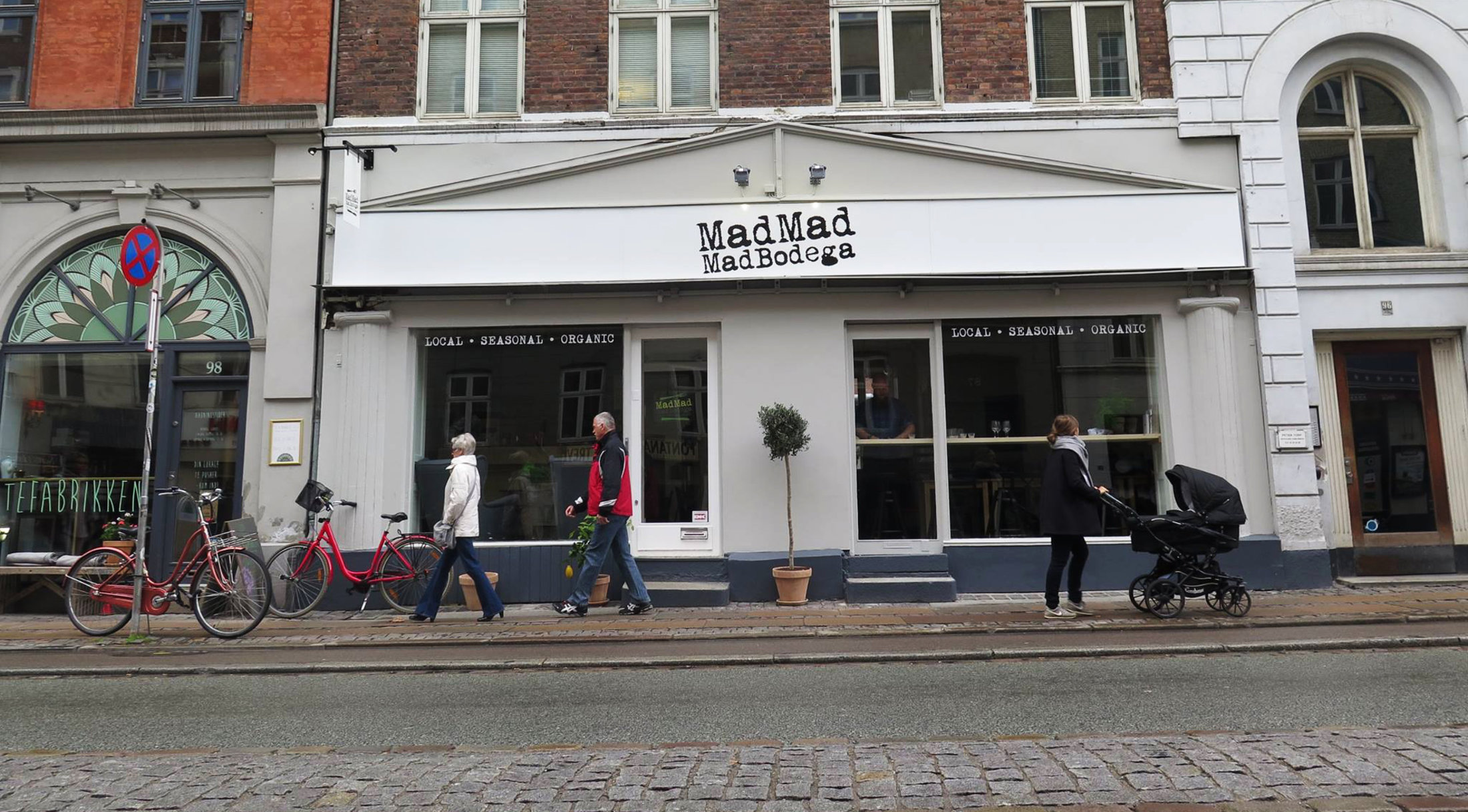
As I was walking down Vesterbrogade, a main street leading from Frederiksberg into Copenhagen’s cosmopolitan centre, I spotted a restaurant on the other side of the street. The restaurant had huge windows, urging people to see the ‘rustic chic’ interior and the bold white words:

“LOCAL. SEASONAL. ORGANIC”

My initial thought was “Uh huh, here’s another restaurant using greenwashing [link] and growing ethical consumerism…all talk and no substance”. I kept on walking. But, the restaurant kept on popping back into my head. Goddamn that rustic chic look, it’s just too inviting. I turned round, crossed the road, and stepped inside MadMad Mad Bodega

Source: aok.dk
Okay, when I say step inside what I really mean is a) see that the restaurant is shut, b) try the door anyway, c) realise its unlocked, d) step around a large chair that is clearly barricading people from entering and e) say “HIII!” to an unsuspecting restaurant owner who is half way through a professional chat with two bearded men.

A friend once told me that I “have no appreciation of social boundaries, but in a totally adorable way”. All I can say is that it wouldn’t have been adorable if I had still been wearing my damp rat anorak.

Once the bearded men had gone, I asked the owner, whose name emerged as Heather, if I could check out the restaurant. In a flurry of enthusiasm and efficiency, Heather gave me a brief run-through of MadMad:

Originally from New York, Heather moved to Copenhagen to do a MBA at Copenhagen Business School after giving up an arts career in London. During the MBA she met Marian, her future business partner, who had a background in computational linguistics. Both had a passion for food, cooking and sustainability, and together they conceived the idea of MadMad Mad Bodega in September 2015. The restaurant opened only two months ago, in May 2015.

Their aim is to serve local, seasonal and organic food but in an accessible and creative way, styling the restaurant as a ‘gastro pub’ and hosting food sustainability workshops on themes such as meat-free meals, preserving foods, seasonality, food waste and climate. For example, perched on top of the wooden bar are small blackboards, revealing compelling statistics and definitions related to sustainable food. Around the restaurant, larger chalkboards hang on the walls, scrawled with information on seasonal foods and upcoming events.

madmad mad bodega copenhagen

madmad mad bodega copenhagen
The names etched into the wood are the individuals who backed the Kickstarter campaign
These offered the perfect platform for communication, never treading over the thin line between raising awareness and appreciation of ethics, provenance and sustainability and shoving it down consumers’ throats.

I was in sustainable food nerd heaven. I didn’t think it could get any better, but it did. 

Wait, let me breathe.

Heather invited me to continue exploring the restaurant, but sadly she was in a rush trying to finalise the ‘soft launch’ for a food sustainability event series that night. 

I definitely didn’t get this subtle ‘do not disturb me’ message. The whole “think before you speak” thing went out the window; the sheer level of adrenaline and endorphins rushing round my body caused me to splurge “OH, CAN I COME?!”

Thankfully, Heather seemed to appreciate ‘my hustle’ (as she fondly put it). Alas, the launch party was full, maybe next time. I cut my losses and proceeded to tell her a bit about what I do, starting with the fact I’d just moved to Copenhagen to work with the Nordic Food Lab on edible insects and diversity and ending with some brief glimpse into the chaotic world that is my freelance food journalist/taste education workshop/consultancy life back in the UK…

She cut me off:

“Okay, you’ve gotta come tonight. I think you’ll love it, it’s a bunch of food bloggers, writers and events coordinators from Copenhagen. The event starts at 6pm, you’ll get a meal and there will be some fun interactive activities. Cool? Now I gotta finish everything. See you then!”

You know how I said I was in sustainable food nerd heaven before? I lied. This was it.

With a few hours to kill, I went and sat by a lake (you know, as Copenhagen’s city centre just has beautiful swan-filled lakes in it). Here, I whipped out my trusty notepad and pen. For the next half an hour, I created hand-made business cards, fit with a little wheat crop and my newfound ‘personal brand’ as a ‘Food Geographer’.

homemade business card rebecca roberts
My business card...
At 6pm, I arrived back at MadMad. Once everyone arrived, we made a total of around 12 people. I sat at a table, nestled between a bunch of exceptionally talented foodies. 

On my left were the co-founders of Scandinavia Standard, an online forum for English-speaking ex pats and general Scandiphiles in Denmark and beyond. Opposite me was Lin, the founder of Guide to Copenhagen, and Hazel, the woman behind the internationally recognised blog Mad about Copenhagen. To my right was Fredrikke, the coordinator of Copenhagen Cooking festival which hosts over 150 food events in Copenhagen, and Ditte, a food writer at The FoodClub and Instagram extraordinaire.

And then there was me. With my little homemade business cards, just lapping up everything like an excited puppy.

My trusty notebook...
Heather and Marian opened the evening with a talk on the reason behind the events series. As the sustainable food movement becomes more prolific, we all know what organic, local and seasonal mean in terms of abstract labels on food products. However, do we really know why they are important, and how we can access and incorporate them in our everyday lives? To answer these, we need to go a bit deeper, providing the ‘ideas, tastes and skills’ surrounding food and sustainability.

These three fundamental concepts paved the way for an exceptional evening. As guests, we acted as guinea pigs to test out the various creative ideas Heather and Marian had concocted for their upcoming workshop series. Rather than simply listing all the things we did, I thought I should focus on the take home messages.

First, we have the choice to make sustainable food decisions three times a day, at breakfast, lunch and dinner.


Despite this, there is a lazy tendency to rely on binaries such as ‘healthy’ and ‘unhealthy’, and increasingly, ‘sustainable’ and ‘unsustainable’ food. While these are good points of reference to help guide eating habits, they paint a pretty simplistic picture of our food system and how we should act in it.

Much of this binary is based on general principle (i.e. morals, ethics, sustainability, health) rather than the specific practice. Let’s take meat as an example. While we should all reduce our intake of red meat for ethical, health and sustainability principles, there is a stark distinction between the practice of eating beef from a feedlot in which cows are fed on corn and kept in inhumane conditions and eating beef from a cow in an organic, pasture-fedlivestock system. While this does not fully address the complexity of the ‘meat dilemma’, it exemplifies that we do not have to reject all meat as ‘unsustainable’, but can make an active choice to solely eat meat that aligns good principle and practice together.

The evening at MadMad encouraged this active choice. For example, to whet our appetites, we did a sustainable cocktail making class. 

The start of our cocktail: strawberry puree. 
While we drank our Absolut vodka and strawberry aperitifs, Heather used the beloved blackboards to inscribe five simple rules when it comes to choosing a ‘green’ cocktail:
  • Try clear
  • Try seasonal
  • Go waste and energy efficient
  • Say yes to fruit based
  • Run away from rum
heather madmad mad bodega

Take the G&T and Mojito as two examples. Gin is a clear spirit, comprised mainly of water. The production of a G&T uses the energy equivalent of switching on the kettle. Rum on the other hand is a dark liquor, reliant on sugarcane and molasses, and is one of the most energy and resourceintensive alcohols out there.

Overall, by putting a bit of legwork in to learn the practice or process behind your food and drink, you realise that there is much more potency in informed choice than choosing according to abstract binaries when it comes to influencing our food system.  

Moving away from cocktails and onto cockerel. 

The second take-home message of the night was that it is not just about availability or access, but also utilisation of our food.


And, as a side point, you can make an extraordinary number of meals from just one chicken.

The World Health Organisation defines food security as: "When all people at all times have access to sufficient, safe and nutritious food to maintain a healthy and active life". This relates not only to availability (i.e. sheer amount) but also access to and utilisation of the food. Utilisation essentially means the use of our food, not only in terms of how our body digests it and its nutritional profile, but also how to make it last longer and waste less of it.

So, we have the idea, what about the skills to help maximise use of our food?

One skill is preservation. Through pickling, smoking, salting, burying, and canning foods, preservation is a fundamental and historic way in which to maximise the longevity and uses of our food.

We were given the humble tomato to experiment with preservation techniques. I want to make this sound much more gastronomically complex (as we are foodies, yah) than it actually was, but literally all we did was pop some raw cloves of garlic and a handful of herbs (marjoram, basil and coriander) into a glass pot with some chilled, blanched (skin-removed) tomatoes. It was SO SIMPLE. And from this simplicity comes deliciousness in a diversity of forms: you can preserve it and make a bruschetta topping, tomato jam, sauce, herby puree…

pimped up preserved tomatoes madmad mad bodega


pimping tomatos madmad mad bodega
Our 'pimped up' tomatoes
A second essential skill is knowing how to use the whole animal or plant

This ‘head to toe’ movement is ever-growing, but is by no means novel. Particularly when it comes to meat and a rejuvenated desire for offal and offcuts, much of our knowledge stems from older generations and how to eat wisely in times of rationing and adversity. 

MadMad went to town with this, inviting Thomas from I Will Cook For Food as chef for the night. A self-taught chef, Thomas learned to cook with the experts - your grandmothers and mothers. He set up the Facebook group 'I Will Cook For Food' in which people could invite him to come and learn how to cook authentic, home-cooked meals in their own kitchens. Now, he has transferred their passion onto our plates, and damn it was tasty. 

chicken ballotines i will cook for food
Chicken ballotines, offered by Thomas

chicken ballotines madmad mad bodega

Food included crisp bread spread with chicken liver pate, fruit jelly and tarragon; minced chicken stuffed inside salted and spiced chicken skin; chicken fricassee with crème fraiche, sage and dill, stuffed inside a molasses and fermented garlic-based puff pastry*.

*Thomas and MadMad Mad Bodega are also doing a Meat-Free Monday series, building on the idea of creating delicious, nutritious meals from seasonal vegetables rather than relying on meat for a ‘protein fix’.

madmad mad bodega food
Chicken fricasee in a garlic and mollases puff pastry
We also had a chance to try our hand as culinary maestros. Using only five ingredients and two ‘wild cards’ (we chose chicken – obviously – and honey), we had five minutes to come up with as many meals as possible. Our ingredients included red onions, butter, oats, cabbage and eggs. From just these staple foods, we ended up with fifteen different meals ranging from oat koji and porridge to steamed cabbage wraps filled with chicken, egg and onions.

ready steady cook activity
Our 'Ready Steady Cook' task: 5 ingredients, 2 wild cards...make a meal!
From all of the above, there is one final take home message:

There is an important distinction between diversity and choice when it comes to our global food and agricultural systems. 


To make my point, imagine walking into a supermarket. We enter and are confronted with a limitless choice of food products. However, if we take a closer look, how much diversity is there in this? Many of the food products will include corn, soy or rice in their various forms, and through the use of additives and marketing tweaks, food manufacturers can sell pretty much the same product as an ‘original’, ‘low fat’, ‘extra chunky’, ‘low salt’ alternative. In other words, while we may have choice, we have very limited diversity of crop and animal species ending up in our supermarkets. It is a 'diversity-sameness' paradox. 

What is very clear from the MadMad event is that, as eaters, we can help to incorporate (or at least appreciate) diversity into our food systems. Ironically, this often means actively limiting our ‘choice’: selecting foods in season rather than assuming its available all year round; opting for only pasture-fed beef or free-range chicken; cutting out meat all together and exploring the diverse world of vegetarian cooking; buying locally grown or heritage produce; or trying underutilised species and traditional foods.

Hopefully these take-home ideas educate and inspire, but you’ll just have to visit Mad Mad in Copenhagen to let the tastes invigorate and satiate, and the skills equip you with the ability to continue utilising and passing on this knowledge and diversity…

Love Bug: Taste Education and Edible Insects


After five months of us saying we are going to do a pop-up dinner together, Annie and I finally did it. Our first event was a traditional aphrodisiac and edible insect themed event; a sure fast way to rid ourselves of the pent up frustration over when/where/how/what to do a pop-up on.

Love Bug edible insect aphrodisiac pop up menu

I would like to say that the notion of ‘Love Bug’ came from an intellectually stimulating debate over artisan coffee, but instead it evolved during a filming session where Annie and Charlotte were feeding insects to a poor man named Craig and I was swigging at hornet liquor. 

So, the big question: Why did we incorporate ‘eating insects’ and ‘eating n’sex’?

Well, there are many reasons. First and foremost, I find the above play on words utterly hilarious. So did my mother when she asked what I got up to in Japan, and I nonchalantly said ‘Well, just a lot of eating insects’. Let’s just say, it got lost in translation.

No, in all serious, contrary to popular belief that oysters and champagne are the winning combination, many edible insects are a potent aphrodisiac alongside other foods such as chilli, avocado, wasabi, basil and banana.  

For example, in sexual entomology (yes, that’s a thing), insects are a ‘symbolic charm’ that produces physiological effects (i.e. real or placebo) of sexual and pleasure enhancement. In India, queen termites are a delicacy due to their procreative capacity, and in Mexico, the chapuline or grasshopper has similar effects due to its ability to lay numerous eggs. This aligns with a wider belief that ‘you are what you eat’. Worldwide, bees – and their byproduct, honey - are said to increase genitalia size and help you become more attractive. Perhaps this is where the desire for ‘bee stung’ lips comes from. Alongside symbolism, some insects produce ‘love drugs’; the Spanish fly secretes cantharidin, an aphrodisiac remedy used in the US in the early 1900s.

chilli cocktails taste education oxford
Chilli-infused cocktails to get your heart racing
We wanted to use Love Bug as a platform for 'taste education' on edible insects and aphrodisiacs. Taste education is a concept that embraces pleasure, conviviality and appreciation of food and its diversity. As Slow Food states:


“by understanding where our food comes from, how it was produced and by whom, adults and children can learn how to combine pleasure and responsibility in daily choices and appreciate the cultural and social importance of food”.

There is a tendency in Western culinary culture to group all insects into one homogenous blob: ‘pest’, ‘disgusting’, ‘primitive’. There are of course exceptions to the rule. In the US, flies and crickets have been farmed but, as it’s mainly for animal and fish feed rather than human food, attention has been limited. In continental Europe, milbenkase (mite cheese) is traditional to Germany and casu marzu is a delicacy in Sardinia. However, with stringent health and safety regulations and a stubborn prioritisation of large domesticates such as cows and pigs over protein-rich grubs, these examples are few and far between.

Increasingly, this is changing. As we speak, the notion of edible insects as an alternative protein source is breaking out of its cocoon and morphing into the glorious butterfly that is a ‘global solution to world food, health and climate crises’.

If insects do become the next big thing, it is crucially important to understand the diversity underpinning them. This includes taxonomic diversity, biodiversity, knowledge and gastronomic diversity. Without appreciating this and integrating it into our utilisation of edible insects, we risk losing everything that makes them valuable in the first place.


bug banquet banner oxford
The amazing banner donated by Bug Banquet!

Hosted at the artisan oil and spirits store Demi John, Love Bug encouraged guests to eat and savour new foods, but also actively discuss and engage with the stories behind them. In this sense, we provided a platform for 'informed eating', aligning with the quote“Eating is a necessity, eating intelligently is an art”. 

Guests were urged to doodle and scribble their thoughts, tastes and experiences onto the paper tablecloth. The resultant collage or 'food doodle' (foodle) not only showed enjoyment and creativity, but also gave valuable information on the perceptions and reactions to edible insects.

love bug taste education oxford

food doodle taste education workshop oxford
The final 'foodle' collage!
When it came to actually choosing the elements of the three course meal, there was a trade off. If we want to incorporate insects into Western food culture, we will have to sensitise people to them and challenge prerequisite values and culinary beliefs. ‘Hiding’ insects in known foods is one way of doing so, either by using insects as a food additive (e.g. cricket flour bars) or or blending them into foods with familiar tastes such as tacos, pasta and chocolate. 

This may help to encourage consumer interest and consumption, but what about nutrition and health? By dipping insects into chocolate or using them in meal supplements, are we not simply reinforcing the systemic health and sustainability challenges that insects are meant to be solving in the first place?

We tried to find a balance between the two, providing a meal that a) included ‘well known’ foods and b) was healthy and nutritious. We even went a bit further, with some insects being plainly visible in the food and others incorporated in a sauce. 


cucumber avocado grasshopper sushi
Annie hard at work making grasshopper, avocado and cucumber sushi 

The final meal consisted of: 

  • A chilli-based cocktail
  • Homemade grasshopper, avocado and cucumber sushi with a seaweed salad
  • Fresh pasta with silk-worm, tomato and basil sauce and chilli prawns
  • Vegan banana ice cream with honeycombe and sugar shards, topped with wasp larvae and chocolate-dipped fruits. 


silkworm and tomato pasta oxford taste education
Annie making homemade pasta and silkworm and tomato sauce
We did provide some extra additions too, thanks to the Bug Banquet teams ‘grasshopper and white chocolate petit fours’ (Okay, everyone needs a treat...) and Christine's generous donation of all-natural, wholefood cricket protein bars from Crobar. 

bug banquet white chocolate grasshopper
Enticing little grasshopper petit fours 

Overall, we were able to harness the curiosity surrounding entomophagy and allow people to try insects and traditional foods, but in a way that respected rather than undermined the health, sustainability and diversity foundations. 


rebecca roberts annie zimmerman taste education
Annie and I at the end of the evening

We are hoping to continue this quest in the future, not only through a fantastic Bug Banquet event [check out our Kickstarter page!] at Green Man Festival in August 2015, but through more pop-up dining workshops.

If you want to know more about these and our availability, or want to suggest a food/agricultural theme for a future event, please get in touch via: becca.jbroberts [at] gmail [dot] com.